Is quick commerce worth it for your brand?A margin calculator, and how to own the second order.
Ten minute delivery can grow your sales and quietly shrink your margin. Here is how to know which one is happening to you, before you sign.
 By Madhur Tyagi
· 13 min read · Facts checked 3 Nov 2026

Quick answer
Is quick commerce profitable for D2C brands? It can be, when your gross margin is around 70% or more. In our worked example a ₹599 product keeps about a third after commission, ads, fees and write offs. A 55% margin product keeps almost nothing.
Key takeaways
- Commission is the smallest line. Ads, per unit fees, freight and unsold stock sit on top of it.
- Industry estimates put the comfort zone at about 70% gross margin, as reported by StartupTalky in October 2026.
- Our ₹599 skincare example keeps ₹186 (31%). The same price at a 55% margin keeps ₹48 (8%).
- Quick commerce rents you reach. It does not hand you the customer. Plan the second order from day one.
- Run your own numbers in the calculator below before you sign a term sheet.
Written by Madhur Tyagi, founder of The Human Algorithm. 8+ years, 25+ brands, since 2017.
Your product reaches the buyer in ten minutes.
Your money reaches you much later. And smaller.
Every D2C founder in India knows this phone call. A category manager from a quick commerce app. Dark stores in dozens of cities. Lakhs of people who already have the app open.
It sounds like the answer to rising ad costs. Sometimes it is.
Sometimes it is the fastest way to sell a lot and keep very little.
Think of a stall at a busy railway station. Thousands of people walk past every hour. You will sell more there than in your quiet lane shop. But the rent is high, the station decides where you stand, and the buyer remembers the station, not your name.
Quick commerce is that stall. Worth it when your margin can pay the rent.
So let’s find out if yours can. With your numbers, not mine.
Is quick commerce profitable for D2C brands? The honest answer
Yes, for some brands. No, for many.
The dividing line is your gross margin. That is the share of the price left after the product itself is paid for.
StartupTalky’s October 2026 report on quick commerce costs says industry estimates put the real threshold at about 70% gross margin before the channel turns profitable. It also notes that brands that talk about it as a growth channel cluster in beauty, personal care and premium snacking.
Why so high? Because a quick commerce sale has many hands in it. Each one takes a share before you see a rupee.
Where ₹599 goes: one product, every cost
Here is a worked example we built. A ₹599 skincare serum, price net of GST. It costs the brand ₹150 to make and pack. That is a 75% gross margin.
We used a 20% commission, ads at 10% of sales, ₹40 per unit in platform fees, ₹25 to move stock to the warehouses, and 3% lost to damage, expiry and unsold returns.
Worked example · illustrative, not client data
One ₹599 serum, split
Before your own team, rent and the second order
Now run the same ₹599 price on a lower margin product, like a basic apparel pack. Say it costs ₹270 to make, a 55% gross margin. Sizes and returns push write offs to 6%.
| At ₹599 | Serum 75% margin | Apparel 55% margin |
|---|---|---|
| Product cost | ₹150 | ₹270 |
| Commission, ads, fees, freight | ₹245 | ₹245 |
| Write offs | ₹18 | ₹36 |
| Kept | ₹186 31% | ₹48 8% |
Same app. Same price. Same fees. One brand keeps ₹186. The other keeps ₹48, and one extra discount week wipes that out.
That is the whole story of quick commerce in one table. Category decides everything.
Our numbers are illustrative and net of GST. If you are GST registered, the GST charged on commission is usually claimed as input credit, but it still ties up cash until you claim it. Ask your CA for your case.
What does quick commerce really cost a brand?
The commission rate is what everyone negotiates. StartupTalky calls it “the smallest number on the page.” Here is what sits around it.
None of these are secret. They are just not on the opening slide of the pitch. Treat every number here as a starting point and check it against your own contract.

Calculator: what does your brand keep on quick commerce?
Put in one SKU at a time. Use your real cost, including packing. If you don’t know a number yet, start with one of our examples and change one box at a time.
Tool · per unit, net of GST
Quick commerce margin calculator
Where do most of your repeat orders happen today?Pick one to see your next step
Our verdict bands are our own rule of thumb, labelled as ours: keep 25% or more and it is worth a test. Between 12 and 25%, go carefully. Under 12%, fix the price, the pack or the cost before you list.
Rent reach, own repeat: the framework
Here is the part most quick commerce guides skip. Even a good margin on the opening order is not the prize. The prize is the second order, and the tenth.
On the app, the buyer comes back to the app. On your site or your WhatsApp, the buyer comes back to you. So we use one simple rule.
Save this · The Human Algorithm.
Rent reach, own repeat
Rent the station · own the regulars
Save it, or send it to a founder friend
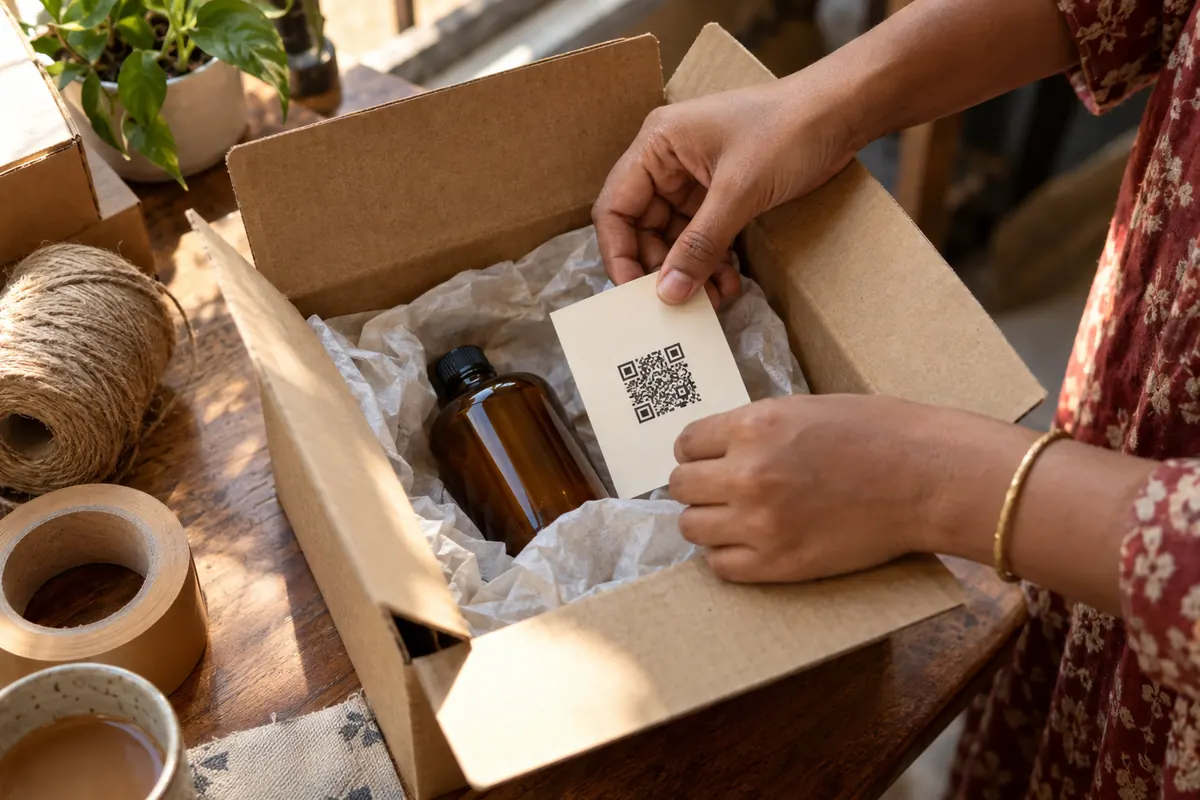
Send on WhatsAppOne honest note. Your seller terms may have rules about what can go inside a pack. Check them before you print a card. Keep it a thank you and a care guide, never a coupon that undercuts the app.
When the buyer does come to your WhatsApp, every message is a person who already likes your product. Reply like it. If you want the full plan for that moment, read our guide to repeat customers on WhatsApp.
Scripts to win the second order
Copy these. Change the words in brackets. Keep the tone warm and short.
Free kit: 4 scripts for the second order
1 · The card inside the box
Thank you for picking [brand]. You are one of the people we make this for. Scan to get your free [how to use guide / refill reminder] on WhatsApp. A real person from our team replies.
2 · The reply when they scan
Hi [name], thank you for scanning! Here is the [guide]. Quick question so I can help better: what made you try [product]? Reply in one word, and I will send you two tips that fit you.
3 · The refill nudge (send around day [25])
Hi [name], by now your [product] is probably close to done. Want me to keep one aside for you? Reply YES and I will send the link with a small thank you for coming back to us directly.
4 · Hinglish check in
Hi [name], [brand] se [your name] yahan. [Product] kaisa lag raha hai? Agar kuch theek nahi laga toh seedha bataiye, hum sach mein sunte hain. Aur pasand aaya toh next order yahin WhatsApp pe kar sakte hain.
Checklist before you list on quick commerce
From the Unicommerce seller guide (15 Sep 2026) and the cost stack above. Tick these before the category manager’s next call.
- Papers ready: GST registration, PAN, a business bank account, FSSAI or other product licences, and brand authorisation if you are not the brand owner.
- APOB in place: an Additional Place of Business on your GST for states where you will send stock. The guide says approval can take days or weeks.
- Barcodes right: a valid barcode per SKU, GS1 where required, that matches the listing and scans on the pack.
- Shelf life: the guide notes stock should have 90+ days of shelf life at inwarding.
- Margin math per SKU: every SKU through the calculator. Not every SKU belongs on the app.
- Ad budget set: a monthly ad number you can afford, counted as a cost, not a bonus.
- Stock plan by city: start with the cities where you already sell well. Unsold stock across many dark stores is where margin leaks.
- Return plan: the card, the QR and the WhatsApp replies ready before the opening order ships.
When should a D2C brand say no to quick commerce?
Saying no is a strategy too. Think twice when:
- Your gross margin is under about 55%, and you can’t raise the price or change the pack.
- You sell sizes, fits or many variants, so returns and write offs climb.
- The product is a considered buy, not an urgent or impulse one.
- Your cash is thin and stock sitting in dark stores would hurt.
- Your app orders rise while your own site orders fall in the same cities. That may mean you are swapping your loyal customers for rented ones.
How we use it at The Human Algorithm.
Our promise is one line: an AI that feels human and keeps improving itself. For a D2C brand, that means the moment a quick commerce buyer scans your card, someone replies warmly, remembers what they bought, and makes the next order easy.
You are the hero of that story. Your product earned the scan. We just make sure nobody who scans is left on “seen”.
Our method, labelled as ours
How a repeat desk gets better every week
- We run your SKUs through the margin math. Together, so you know which ones belong on the apps.
- We write the card, the scan reply and the refill nudges in your voice.
- You approve, then we learn. Each week we look at who replied, who reordered and what you edited, and we improve the messages.
Save this
The quick commerce rule card
- Margin before the app. Aim for about 70% gross margin before you list.
- Count every line: commission, ads, fees, freight, write offs.
- List the SKUs that pass. Keep the rest on your own channel.
- Put a reason to return in every box.
- Serve the second order yourself, with a real reply.
Screenshot this. Check it before every term sheet.
Questions founders ask
Is quick commerce profitable for D2C brands?
It can be, mainly for products with a gross margin around 70% or more that people buy often. Industry estimates reported by StartupTalky in October 2026 put the threshold near 70%. In our worked example a ₹599 product with a 75% margin keeps about a third. At a 55% margin it keeps almost nothing.
How much commission do quick commerce apps charge brands?
Reported rates are usually 15 to 25% of selling price (StartupTalky, Oct 2026). A Unicommerce seller guide (Sep 2026) puts Blinkit at 8 to 20% depending on category. On top of commission, Blinkit lists inwarding, storage, fulfilment, return and removal fees. Your category manager confirms the exact rates.
What gross margin do I need to sell on Blinkit, Zepto or Instamart?
Aim for about 70%. Below about 55%, commission, ads, fees and write offs usually leave very little per unit. Run each SKU through a margin calculator with your own contract numbers before you list.
Should I sell on quick commerce or my own website?
Usually both. Use quick commerce for reach, trial and urgent buys on your highest margin SKUs. Use your own site and WhatsApp for repeat orders, bundles and the customer relationship, where you keep the margin.
How do I get repeat customers from quick commerce orders?
Put a small thank you card in every pack with a QR to your WhatsApp and a real reason to scan, like a how to use guide or a refill reminder. Reply warmly when they scan, then serve the next order on your own channel. Check your seller terms on what can go in the pack.
Is quick commerce good for clothing brands?
It is harder for most apparel. Sizes and variants push up returns and write offs, and margins are often lower. Simple, high margin basics and accessories have a better chance than fitted styles.
The station will keep getting busier. Good. Rent the stall when the maths works. Then give every buyer a reason to find your shop.
About this guide: sources, all checked 3 Nov 2026. StartupTalky, “What Quick Commerce Actually Costs D2C Brands”, 5 Oct 2026 (commission range, commission plus ads estimate, the 70% gross margin estimate, return to vendor). Blinkit Seller Hub, “Fees and Commissions” (fee types, page undated, read 3 Nov 2026). Unicommerce, “How to Sell on Blinkit in 2026”, 15 Sep 2026 (documents, APOB, barcodes, shelf life, 8 to 20% commission estimate). eChai, quick commerce margins and listing fees (listing fee as ad wallet credit, undated). All commission and fee figures are reported estimates, not official rate cards. The ₹599 worked examples, the calculator, its verdict bands and Rent reach, own repeat are ours, labelled as ours. Madhur Tyagi is the founder of The Human Algorithm., a growth and automation practice in New Delhi that helps Indian founders, coaches and creators reply faster, follow up kindly and earn trust in their DMs and WhatsApp. 8+ years, 25+ brands, since 2017.
THA Circle
Use AI. Still sound human.
A free WhatsApp channel for founders, coaches and creators who want AI to save time without losing the human touch.
- On joining A welcome pack: 3 AI prompts and 5 chat scripts you can copy today.
- Monday A short script for your own chats. Ten minutes to try.
- Wednesday One real chat taken apart, names removed.
- Friday Human of the Week. A moment a customer felt seen.
Free. Takes ten seconds. Channel followers stay private. Leave any time.
The Sunday note
How people pay attention, and how to earn it. One email a week.
I study AI, attention, human psychology and marketing. Every Sunday I send one idea and one script for your chats. Five minutes to read. Reply any time, I read every answer.
Get the Sunday noteFree. Leave any time. Your email stays private.
 Repeat buyers
 Repeat buyers
 Repeat buyers