How Indian D2C brands use AI agents, and what to keep human
By Madhur Tyagi · · 9 min read
2:07 AM. A buyer in Indore asks your brand on WhatsApp, “Does this perfume last all day?”
Nobody replies. By 10 AM she has paid a brand that did.
A made up scene: Meera runs a small perfume brand from Jaipur, and she was asleep. Most D2C founders have lived a real one.
The short answer
Indian D2C founders get the most from AI agents on five repeat jobs: answering product questions from facts you wrote, confirming cash on delivery orders, sending one helpful cart reminder, asking for reviews after delivery, and putting the weekly numbers in one note. The agent says it is AI, works from your facts sheet and hands anything about money, anger or health to a person. Keep refunds, discounts, complaints and brand decisions human. Start with one job, test it on 20 tricky messages, read the real chats yourself, then add the next.
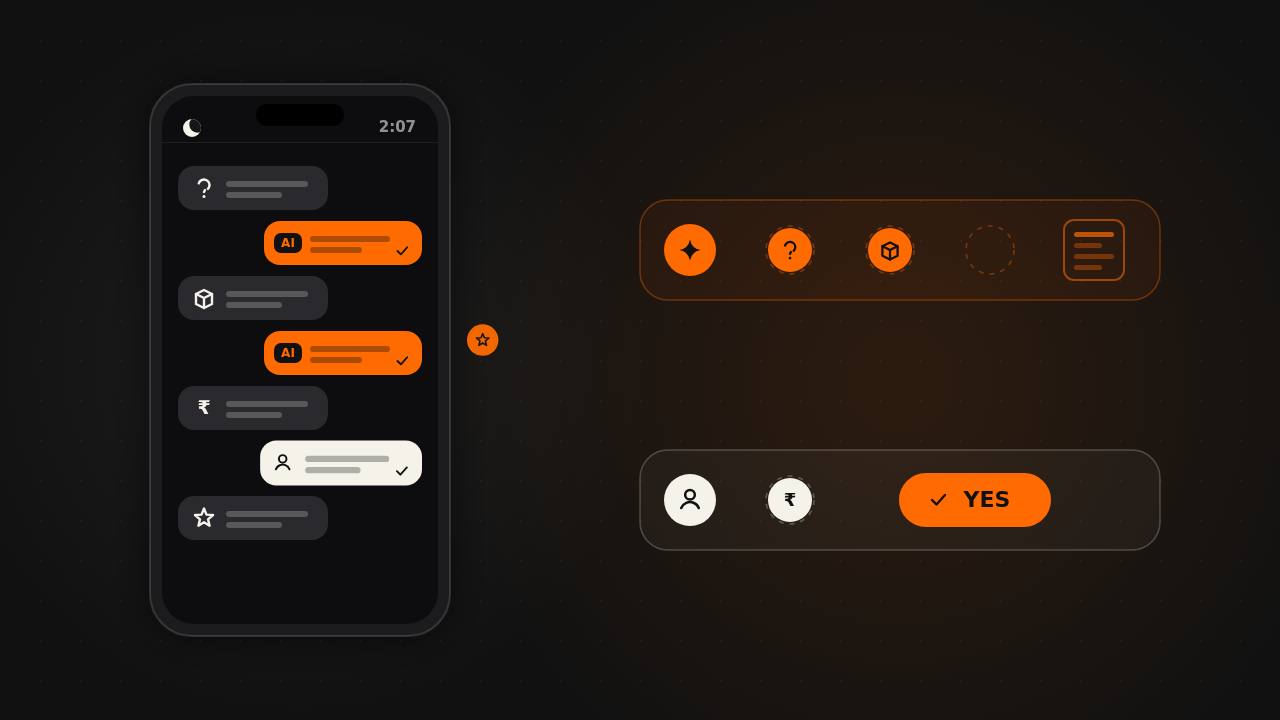
Most D2C founders I talk to have stopped asking “should we use AI?”. They ask a sharper question now: “Which jobs can I hand over without my customers feeling it?”
That is the right question. An AI agent is good at repeat work with clear rules. It is weak at judgment, feelings and money. Get that split wrong and you save an hour but lose a customer.
Key takeawayGive the agent the repeat work. Keep the judgment, the feelings and the money with a person.
I have run ads and lead systems for 25+ brands since 2017, and DM automation since 2018. Here is how I would split the work for an Indian D2C brand in 2026: five jobs an agent can take, the lines that stay human, and a 7 day way to start.
What does an AI agent actually do for a D2C brand?
An AI agent is software that reads a customer message, checks your own data and then drafts a reply or takes one small step. It might look up an order, check stock or read back an address. When it is not sure, it asks a person.
Think of it as a new hire on day one with a very good rulebook. It knows every policy you wrote down. It does not know what you would do when a loyal customer is upset.
Customers already expect this kind of help. In a Gartner survey of 3,566 customers run in February and March 2026, 58% of those who use GenAI had already used it to get a task done for them, not just to get an answer.
The same survey carries the warning. 87% said a company using GenAI for service must give them a way to reach a human. Keep both numbers in mind for the five jobs below.
Up next So which jobs pass both tests? Start with the one that arrives at 2 AM.
Can an agent answer product questions at 2 AM?
The job: “Does it last all day?” “Is it okay for oily skin?” “When will it reach Lucknow?” These questions arrive late at night, and the same 30 come back again and again.
Some brands do not even give the question a place to land. When we opened 100 Indian D2C homepages on a phone on 19 October 2026, 17 had no WhatsApp link, no chat window and no signup field.
How an agent helps: you write a facts sheet once. Notes for each product, delivery days by region, return rules, COD charges. The agent answers from that sheet and nothing else. It says it is an AI assistant. When a question is not on the sheet, it says so and tells the buyer when a person will reply.
Keep human: anything about health, allergies or skin reactions. A wrong answer there is not a lost sale. It is a hurt customer.
Copy this (instruction for the agent):
“Answer from the facts sheet below and nothing else. Say you are an AI assistant in your opening line. If the answer is not on the sheet, say a person will reply by [time]. Never guess about skin, health or allergies.”
Copy this (reply the buyer sees):
“Hi! I am the [Brand] assistant, an AI. [Product] lasts about [hours from your sheet] on skin. Want me to share the travel size so you can try it?”
Up next That answer brings the order in. The next job decides whether the parcel comes back to you.
Should an agent confirm cash on delivery orders?
The job: a COD order arrives with half an address and a number that may be wrong. You ship it, it comes back, and you pay the courier both ways.
The numbers are not small. Unicommerce’s India D2C Report 2026, built on 410M+ shipments across 6,000+ brands, puts return to origin at 39.2% at the festive peak. The brands that brought it down made a few changes together, and one of them was checking the address before dispatch.
How an agent helps: it messages every COD buyer soon after the order, reads back the item, the amount and the pin code, and asks for one reply. A clear yes goes to packing. A changed address or a vague answer goes to a person.
Keep human: cancelling an order or marking a buyer as fake. The agent flags it. A person decides.
Copy this:
“Hi [name], this is the [Brand] order assistant, an AI. You ordered [product] for ₹[amount], cash on delivery, to pin code [pin]. Reply 1 to confirm or 2 to change the address.”
Up next A confirmed order is half the story. Seven in ten carts never reach the order button.
How should an agent handle abandoned carts?
The job: Baymard Institute averages 50 studies and puts the cart abandonment rate at 70.22%. Seven in ten carts are left behind.
Many brands answer with a discount blast. That teaches buyers to wait for the coupon.
How an agent helps: one reminder, a few hours later, that answers the doubt buyers usually have at that step (size, delivery days, COD, returns) and offers help instead of a discount. If the buyer replies, the agent answers from the facts sheet.
Keep human: discounts. Any coupon, offer or price change waits for your yes. Our own THA Agent Desk runs on the same rule: every price waits for a person.
Copy this:
“Hi [name], you left [product] in your cart. Most buyers ask about [size, fit or delivery] at this step, so here it is: [one line answer]. Need help choosing? Just reply here.”
Up next The sale is not the end. One message after delivery decides whether she buys again.
Can an agent ask for reviews and reorders?
The job: after delivery, nobody asks how it went. Happy buyers forget to leave a review. Unhappy ones go to your Instagram comments.
How an agent helps: a few days after delivery, one short message asks how it is going. A happy reply gets the review link. When a pack is likely to run out, based on its size, one refill reminder goes out.
Keep human: every unhappy reply. The handoff is what makes people willing to use the agent at all. Salesforce found that 45% of consumers are more likely to use an AI agent when there is a clear way to reach a person.
Copy this:
“Hi [name], your [product] reached you on [day]. How is it so far? Reply 1 if you love it or 2 if something is off. If it is 2, a person from our team replies today.”
Up next Four jobs talk to your buyers. The fifth talks to you, every Monday morning.
Can an agent run your weekly numbers?
The job: every Monday someone opens the store dashboard, the courier panel, the ads account and the WhatsApp inbox, and copies numbers into a sheet. It takes an hour and is out of date by Tuesday.
How an agent helps: it pulls the numbers into one short note: orders, COD share, RTO, ad spend and the questions customers asked most. Then it points out what changed. You decide what to do about it.
Keep human: the decision. An agent can tell you RTO went up in one city. It cannot tell you whether to stop COD there, because that depends on what you know about your buyers there.
Copy this (instruction for the agent):
“From this week’s order and ad sheets, list: total orders, COD share, RTO count, ad spend, the 5 questions customers asked most, and the 3 numbers that changed most since last week. Do not guess. If a number is missing, write ‘missing’.”
Up next Five jobs an agent can take. Now the harder list: what you should never hand over.
What should a D2C brand always keep human?
Here is my list. Keep it next to your yes rules.
- Refunds, discounts and price exceptions. Money going out needs a person’s yes.
- Complaints and angry customers. They want to be heard before they want a fix.
- Health, skin and allergy questions. A guess here can hurt someone.
- New offers and your brand voice. The agent copies your voice. It should not invent it.
- Deals with creators, wholesalers and partners. Relationships are not tickets.
- Cancelling an order or blocking a buyer. The agent flags. A person decides.
Two more rules sit on top of the list. Every agent message says it is AI, because nearly 75% of consumers told Salesforce they want to know when they are talking to an AI agent. And every chat shows a way to reach a person. Gartner’s 2026 survey found customers “will push back when AI acts as a barrier to reaching a human.”
An agent should take work off your team, not put a wall between you and your buyers.
This is the same lens behind our work with a D2C fragrance brand: 3.5x+ ROAS on Meta for 6+ months, with 35% lower CPL. That result came from ads and lead work, not from an AI agent. It taught me what this article is about. The ad brings the buyer. What happens in the chat after the click decides whether she stays.
Up next So how do you start without risking the brand you built? One job, seven days.
How do you start in 7 days without losing trust?
Pick one job. Not five. Here is the week I would run.
- Day 1: choose the job. COD confirmation or product questions are the easiest to check.
- Day 2: write the facts sheet and the yes rules: what the agent may say, and what must wait for a person.
- Day 3: write 20 tricky test messages, in Hinglish too. “Bhai price kam hoga?” “COD pe extra charge hai?” “Gift wrap milega?”
- Day 4 and 5: run the tests and read every answer. When an answer is wrong, fix the sheet, not the single reply.
- Day 6: go live for that one job, with the AI label and a clear way to reach a person.
- Day 7: read the opening 50 real chats yourself. Then decide on the next job.
Want someone to build that one job with you? WhatsApp automation for D2C brands shows how we set up one flow, and you approve every word.
Back to Meera and her 2:07 AM buyer in Indore. With job one in place, the buyer gets an honest answer from Meera’s facts sheet, marked as AI, before she opens another brand’s page. A refund question that lands at 3 AM waits for Meera’s yes at 9. She wakes up to an order and one decision, not a lost sale.
Key takeawayOne job, a written facts sheet, an AI label and a way to reach a person. That is the whole safe start.
Not sure which job to hand over? Leaks in replies and follow up usually sit closest to the money. The free Growth Leak Check asks 7 quick questions in 2 minutes and shows your top 3 leaks, each with one fix.
AI or human? Sort your own tasks
Every buyer question that waits till morning can become a sale you never see. And one wrong refund sent without a human yes can cost you a loyal customer. The 10 tasks below take about a minute to sort.
AI or human? Tap where each task belongs.
10 everyday D2C tasks. Your answers stay in this browser.
Answer “does it last all day?” from your facts sheet
Agent. A repeat question with a written answer. It says it is AI.
Confirm a COD order’s address and amount
Agent. Read back the order, ask for one reply, send unclear ones to a person.
Send one reminder for an abandoned cart
Agent. One helpful note that answers the usual doubt. No discount.
Offer a 20% discount to save a cart
Human. Money going out needs a person’s yes.
Reply to “this gave me a rash”
Human. Health and skin questions are never a guess.
Ask for a review 4 days after delivery
Agent. A short check in. Unhappy replies go to a person.
Answer an angry “where is my refund?”
Human. Angry buyers want to be heard by a person, and refunds are money.
Put weekly orders, COD and RTO into one note
Agent. It pulls numbers and points out changes. You decide.
Decide whether to stop COD in one city
Human. The agent shows the number. The call is yours.
Reply to a creator asking for a paid collab
Human. Deals and relationships are not tickets.
0/10
Matches with our split
Sort the 10 tasks above
Each tap shows our answer and why. Nothing is sent anywhere.
Useful? Send it to your team or keep the checklist.
Opens WhatsApp with the link ready. You choose who gets it. Save gives you a one page checklist to print or keep as a PDF.
Your checklist before an agent talks to customers
- Every agent message says it is AI.
- The agent answers from a facts sheet you wrote and checked.
- Prices, discounts and refunds wait for a person’s yes.
- Complaints, health and skin questions go to a person.
- Every chat shows a way to reach a person.
- You tested 20 tricky messages, Hinglish included, before going live.
- You read the opening 50 real chats yourself.
- One job at a time. The next job waits until this one holds.
Want the full playbook for parcels that come back unsold? Read why COD orders come back, and 7 ways to cut RTO.
Sources (checked 21 October 2026)
- Gartner: Survey Finds 87% of Customers Say Companies Using GenAI for Customer Service Must Provide Access to a Human Agent, 4 August 2026 (survey of 3,566 B2B and B2C customers, February and March 2026: 87% want access to a human, 58% of GenAI users had it complete a task for them, the “barrier to reaching a human” line)
- Salesforce: State of the AI Connected Customer research, 31 October 2024 (nearly 75% of consumers want to know if they are talking to an AI agent, 45% more likely to use one with a clear escalation path)
- Unicommerce: India D2C Report 2026 (410M+ shipments, 6,000+ brands, 39.2% RTO at the festive peak, address verification before dispatch as one of the changes. Figures read from the report page, not the full PDF.)
- Baymard Institute: Cart abandonment rate statistics (70.22% average across 50 studies)
- The Human Algorithm: 100 Indian D2C homepages checked on a phone, 19 October 2026 (17 of 100 had no WhatsApp link, no chat window and no signup field)
Questions people ask
What is an AI agent for a D2C brand?
An AI agent is software that reads customer messages, checks your own data such as orders, stock and policies, and then drafts a reply or takes a small step like confirming an address. A good one says it is AI, works from facts you wrote and hands anything unclear to a person.
Which D2C tasks should I give an AI agent?
Give it repeat work with clear rules: product questions from a facts sheet, cash on delivery confirmation, one cart reminder, review and refill requests after delivery, and the weekly numbers note. Keep refunds, discounts, complaints, health questions and brand decisions with a person.
Is it safe to let AI reply to my customers on WhatsApp?
It is safe when three rules hold. The agent answers from your facts sheet, says it is AI, and passes money, complaints and health questions to a person. Test it on 20 tricky messages before go live and read the real chats in the opening week.
Do Indian customers mind talking to an AI agent?
Many do not, as long as they know it is AI and can reach a person. In Gartner’s 2026 survey, 87% of customers said a company using GenAI for service must offer a way to reach a human. Make that path visible in every chat.
How should a small D2C brand start with AI agents?
Start with one job, usually COD confirmation or product questions, and run it for a week before adding the next. The free Growth Leak Check shows where your leads leak in 2 minutes. If you want a person to go through your account, the Growth Leak Audit is ₹9,999. If we do not find 3 fixable leaks, your ₹9,999 comes back.
Your team should read this before an agent talks to a customer.
Opens WhatsApp with the link ready. You choose who gets it.
THA Circle
Use AI. Still sound human.
A free WhatsApp channel for founders, coaches and creators who want AI to save time without losing the human touch.
- On joining A welcome pack: 3 AI prompts and 5 chat scripts you can copy today.
- Monday A short script for your own chats. Ten minutes to try.
- Wednesday One real chat taken apart, names removed.
- Friday Human of the Week. A moment a customer felt seen.
Free. Takes ten seconds. Channel followers stay private. Leave any time.
The Sunday note
How people pay attention, and how to earn it. One email a week.
I study AI, attention, human psychology and marketing. Every Sunday I send one idea and one script for your chats. Five minutes to read. Reply any time, I read every answer.
Get the Sunday noteFree. Leave any time. Your email stays private.
 AI will not replace your sales team
 Keep support human as orders grow
 We ran an AI agent on 36 D2C funnels