Quote sent, then silence? The follow up that gets a yes or a no
By Madhur Tyagi · · 7 min read
In short
Do not send “any update?”. Send every quote with a decision date and a next step, walk the client through it within a day, ask whether the price, the scope or the timing holds them back, offer a smaller yes, and if they stay silent, ask if you should close the file. That message gets a yes or a no.
Why trust this: written by Madhur Tyagi, founder of The Human Algorithm. 8+ years in performance marketing, 25+ brands since 2017, 3.5x+ ROAS for 6+ months and 35% lower CPL for a client, DM automation since 2018, and 15+ coaches and creators.
Jump to the copy paste scripts ↓

Picture Arjun. He runs an interiors studio in Gurugram.
He sent a ₹6.5 lakh quote as a PDF on WhatsApp. Two blue ticks. Then nothing for nine days.
Arjun is made up. The silence after a quote is real for many founders, in India and everywhere else.
You met the client, listened well and sent a careful quote. They read it. Then silence.
In May 2026, a small business owner asked on Reddit what to actually say when a customer ghosts you after a quote. Most of us send “Any update?” and wait again. The follow up that works does not chase. It makes it easy for the client to say yes, ask for less, or say no, and it treats a clear no as a good result.
This guide covers why clients go quiet after a quote, and 5 steps that get an answer, with lines to copy. If the client already said “let me think about it”, read what to reply to “let me think about it” too.
Key takeawaySilence after a quote is usually a hard decision. Make it easy to say yes, less, or no.
I have spent 8+ years in performance marketing, with 25+ brands since 2017. In service sales, the deals we lost were more often lost to silence than to a competitor.
Silence after a quote, in four numbers
Up next You know why clients go quiet. Next: how long to wait before you follow up.
Why do clients go silent after a quote?
Mostly because deciding is hard. Most of them have not said no. The price surprised them, they need to ask someone at home or at work, the timing moved, or they cannot tell your quote apart from another one. Saying no feels rude, so they say nothing.
Silence is a question they have not asked yet. Your follow up should make it easy to ask.
How long should you wait before you follow up on a quote?
Agree on it when you send the quote. Name a day, usually two or three working days later, and say what will happen then. Then the follow up is a promise you kept.
If you did not set a day, follow up within two working days with something useful, not “any update?”.
From our own data: On 25 October 2026, The Human Algorithm sent the same short buying question to 15 Indian D2C brands, as a buyer would. By the next morning, 5 had sent no reply of any kind. Across 30 brands asked on 25 and 26 October, 8 answered the question in full or in part, and none of the 8 followed up when we went quiet. This is an early sample from days 1 and 2 of our Reply Report 2026, with no brand named. It updates after 1 November 2026.
Most businesses wait for the buyer. That is your opening.
From silence to an answer
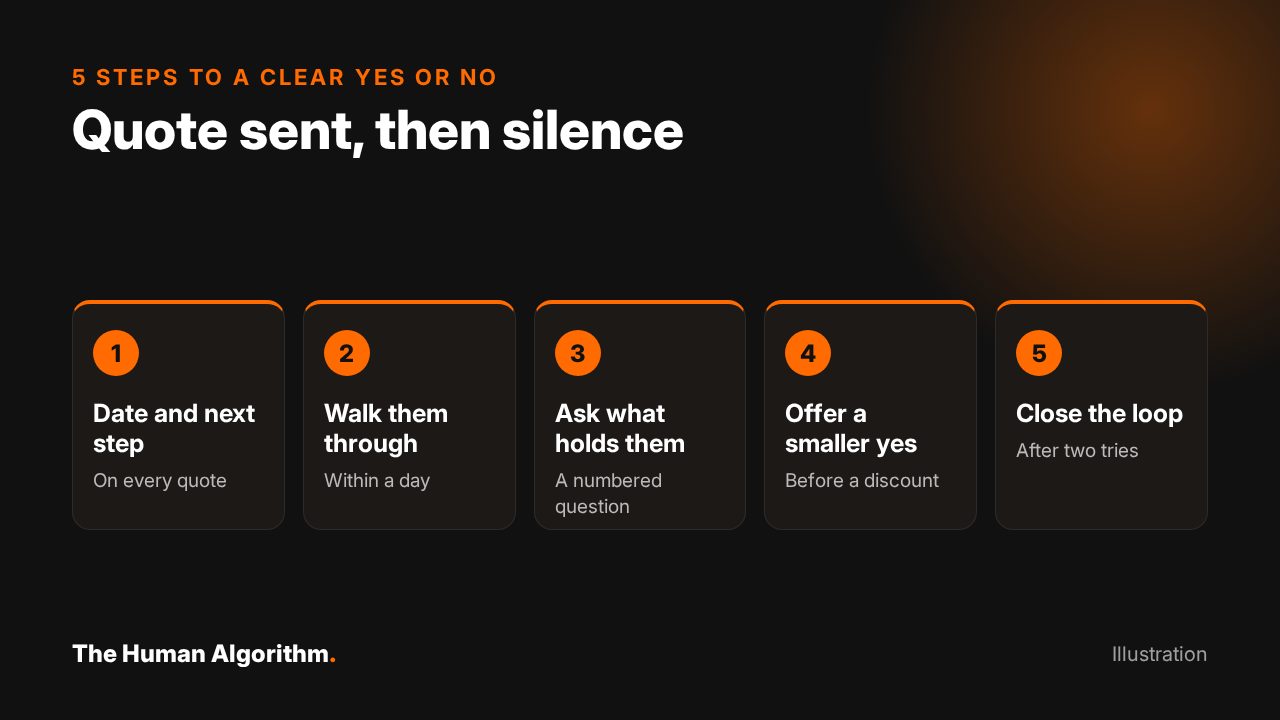
The quote follow up plan
- 1Date and next stepon the quoteValid until, and a call booked.
- 2Walk them throughwithin a dayA short call or voice note.
- 3Ask what holds themnumberedPrice, scope, timing, or another way.
- 4Offer a smaller yesbefore a discountA phase, a smaller start, payment in parts.
- 5Close the loopafter two triesShould I close your file?
Each step below makes the next answer easier for your client to give.
Up next Step 1 is two lines you add to every quote.
1. Does your quote end with a date and a next step?
It should. Every quote needs a valid until date and one agreed next step, like a 15 minute call on Thursday to go through it.
Arjun's quote ended with “Let us know”. No date, no next step.
Why it matters: An open ended quote leaves the next move to the client, and busy clients do not move. A date and a step turn your follow up into something you both agreed on.
Do this: Add “Valid until [date]” on the quote. In the message, write: “I will call you on Thursday at 6 PM to go through it, 15 minutes. Does that work?”
Up next The quote has a date and a step. Next: walking the client through it.
2. Do you walk them through the quote, or just send a PDF?
Walk them through it. A short call or a 60 second voice note on WhatsApp beats a PDF alone. Explain the three numbers that matter and what they get for them.
Arjun sent a 9 page PDF and a thumbs up.

Why it matters: A PDF cannot answer questions. A client who does not understand a line item will not ask, they will go quiet. Your voice also reminds them there is a person behind the price.
Do this: Within a day of sending the quote, send a voice note: “Quick walk through. The ₹6.5 lakh covers the kitchen, two wardrobes and the TV wall. The biggest part is the kitchen, because of the hardware. Happy to adjust anything.”
The same quiet client
Before
Any update?Mon 11:10 AM
Any update on the quote?Fri 6:02 PM
(Seen. No reply.)
After
No rush at all. To help, which is closest? 1. Price is more than planned 2. Change what is included 3. Timing has moved 4. We went another wayMon 11:10 AM
1Mon 1:24 PM
Got it. We can start with the kitchen at ₹3.2 lakh and do the wardrobes after Diwali. Want that version?
Up next The client understands the quote. Next: finding what holds them back.
3. Do you ask what is holding them back?
Yes, with a simple choice they can answer in one tap. Ask whether it is the price, the scope or the timing. People answer a numbered question far more easily than an open one.
Arjun sent “Any update?” twice. Both times, two blue ticks and no reply.
Why it matters: “Any update?” asks the client to write a whole answer about a hard decision. A numbered choice lets them reply with one digit, and it tells you which problem to solve.
Do this: “No rush at all. To help, which is closest? 1. The price is more than planned 2. We want to change what is included 3. The timing has moved 4. We went another way.”
Up next You know the real problem. Next: a smaller yes.
4. Can you offer a smaller yes?
Often you can. If price or timing is the problem, offer a smaller start, a phase, or payment in parts, before you think of a discount.
When a client hinted the quote was high, Arjun cut 10% at once. They still did not reply.
Why it matters: A quick discount tells the client your price was soft, and it does not fix a timing or scope worry. A smaller yes keeps your price honest and gives them a way in.
Do this: “If the full plan is too much right now, we can start with the kitchen at ₹3.2 lakh and do the wardrobes after Diwali. Payment can be in three parts. Want me to send that version?”
A clear no in three days is worth more than a maybe that sits in your head for three months.
Up next There is an easier way in. Next: closing the loop kindly.
5. Do you close the loop kindly?
Yes. If two follow ups get no answer, send one last message that asks if you should close their file. It is polite, it gives them an easy no, and it often brings a reply.
Arjun kept the quote open in his head for weeks and kept planning around it.
Why it matters: A clear no frees your time and your calendar. A kind “should I close this?” message also takes the pressure off, and many clients reply with the real reason or a yes.
Do this: “I have not heard back, so I guess the timing is not right. Should I close your file for now? If anything changes, just message me here.” Then do what they say.
| Step | When | What it does |
|---|---|---|
| 1. Date and next step | In the quote | The follow up becomes a promise you keep |
| 2. Walk them through | Within a day | Answers questions they would not ask |
| 3. Ask what holds them | Two working days later | One tap tells you the real problem |
| 4. Offer a smaller yes | When price or timing is the issue | Keeps your price honest |
| 5. Close the loop | After two tries | Gets a clear yes or no |
A framework by The Human Algorithm.
Key takeawayA date and a next step, a walk through, a numbered question, a smaller yes, then a kind close.
Up next The plan is set. Next: what changed for Arjun, and what it is worth to you.
What changed for Arjun?
He kept the same designs and the same prices. He changed what he sends with a quote and after it.
Every quote now has a valid until date and a call booked to go through it. He sends a short voice note the same day. If a client goes quiet, he asks a numbered question, offers a smaller start, and after two tries he asks if he should close the file.

Some clients still say no. Now they say it in days, not months, and Arjun stops planning around jobs that were never coming. The yes replies come sooner too.
Key takeawayClients still say no. Now they say it in days, and the yes replies come sooner.
What exactly should you send after a quote? Copy paste scripts
Here are 6 messages, one for each step above plus the reply to a yes. Change the words in [brackets], tap Copy, then paste them into WhatsApp or email.
Send the quote with a date and a next step
Here is the quote for [project], valid until [date]. I will call you on [day] at [time] to go through it, 15 minutes. Does that work?
Walk them through it
Quick walk through, [name]. The [amount] covers [main items]. The biggest part is [item], because [reason]. Happy to adjust anything.
Ask what holds them back
No rush at all. To help, which is closest? 1. The price is more than planned 2. We want to change what is included 3. The timing has moved 4. We went another way
Offer a smaller yes
If the full plan is too much right now, we can start with [smaller scope] at [amount] and do [the rest] later. Payment can be in [number] parts. Want me to send that version?
Close the loop kindly
I have not heard back, so I guess the timing is not right. Should I close your file for now? If anything changes, just message me here.
When they say yes
Thank you, [name]! I will send the booking details and the payment link today. We can start on [date].
Save the ones you use most as quick replies in WhatsApp Business, so every quote gets the same follow up.
How much money is sitting in quotes that went quiet?
Every quote left in silence is a decision you let the client put off for you.
It depends on how many quotes you send, your average quote and how many say yes. Put your own numbers in the calculator below. The starting numbers are examples. Swap in yours.
Use your numbers from the last three months. The highlighted line is the extra money the same quotes could bring in each month with a clear follow up.
The quote follow up plan in one place
| Step | Example line | Rule |
|---|---|---|
| 1. Date and next step | I will call you Thursday at 6 PM to go through it, 15 minutes. | Valid until date on every quote |
| 2. Walk them through | Quick walk through. The biggest part is the kitchen, because of the hardware. | Voice note or call within a day |
| 3. Ask what holds them | Which is closest? 1. Price 2. Scope 3. Timing 4. Another way | Numbered, one tap to answer |
| 4. Offer a smaller yes | We can start with the kitchen at ₹3.2 lakh. | Phase or parts before a discount |
| 5. Close the loop | Should I close your file for now? | Then do what they say |
A framework by The Human Algorithm.
Score your quote follow up on the 5 checks
0/100
Quote follow up score
Tick what is true for your quotes today
Each tick updates your score. Use your last 10 quotes.
Useful? Send it to your team or keep the checklist.
Opens WhatsApp with the link ready. You choose who gets it. Save gives you a one page checklist to print or keep as a PDF.
What should you remember?
- Silence after a quote usually means a hard decision is still open.
- Put a valid until date and one next step on every quote.
- Walk the client through it with a short call or voice note.
- Replace “any update?” with a numbered question.
- Offer a smaller yes before a discount.
- After two follow ups, kindly ask if you should close the file.
Sources
- What do you actually say when a customer ghosts you after a quote?, r/smallbusiness. Posted 6 May 2026, per a public archive of the thread read on 25 October 2026. The thread is not India specific.
- The original data comes from days 1 and 2 of The Human Algorithm's Reply Report 2026: one short buying question sent to 15 Indian D2C brands on 25 October 2026 and 15 more on 26 October 2026, checked at 11:30 AM IST on 26 October. Early sample. Brand names are not shared. The full report updates after 1 November 2026.
- Proof numbers are from Madhur Tyagi's own client work since 2017.
Arjun, his clients and their numbers are made up to show the method. They are illustrations.
Questions people ask
What do I say when a client ghosts me after a quote?
Skip “any update?”. Ask a numbered question: is it the price, what is included, the timing, or did they go another way. If there is still no reply after two tries, kindly ask if you should close their file. That message often gets a clear answer.
How many times should I follow up on a quote?
Two follow ups after the quote, spaced a few working days apart, then one kind message asking if you should close the file. Each message should add something, like a walk through, an option or a question.
Should I offer a discount if the client goes quiet?
Not straight away. Ask what is holding them back. If it is the price, offer a smaller start, a phase or payment in parts. A quick discount tells the client your price was soft and does not fix timing or scope.
Is it rude to ask a client if I should close their file?
No. Done kindly, it takes pressure off. It gives the client an easy way to say no, and many reply with the real reason or a yes. Then do what they say.
Should I follow up on WhatsApp or by email?
Use the channel the client used with you. In India that is often WhatsApp, where a voice note and a numbered question feel natural. Keep business emails for the formal quote and the final paperwork.
When should I send the quote?
As soon as you can after the meeting, while the client still remembers the talk. Send it with a valid until date and a booked time to go through it.
Know a founder waiting on a quote reply? Send them this.
Opens WhatsApp with the link ready. You choose who gets it.
Want this handled for you? Revenue Desk: a managed DM sales desk for brands, coaches and creators.
THA Circle
Use AI. Still sound human.
A free WhatsApp channel for founders, coaches and creators who want AI to save time without losing the human touch.
- On joining A welcome pack: 3 AI prompts and 5 chat scripts you can copy today.
- Monday A short script for your own chats. Ten minutes to try.
- Wednesday One real chat taken apart, names removed.
- Friday Human of the Week. A moment a customer felt seen.
Free. Takes ten seconds. Channel followers stay private. Leave any time.
The Sunday note
How people pay attention, and how to earn it. One email a week.
I study AI, attention, human psychology and marketing. Every Sunday I send one idea and one script for your chats. Five minutes to read. Reply any time, I read every answer.
Get the Sunday noteFree. Leave any time. Your email stays private.
 Sent the payment link, then nothing?
 The 14 days after a coaching client pays
 WhatsApp usernames: what businesses must do