WhatsApp and Messenger 24 hour rule: keep the chat, keep the customer
By Madhur Tyagi · · 15 min read · Last updated 23 Oct 2026

Kavya sold 140 candles in one Diwali week, all through Instagram DMs.
By January she could not reach a single one of those buyers.
Kavya is a made up Jaipur founder. If your DMs feel full and your repeat orders feel thin, you know her week.
The short answer
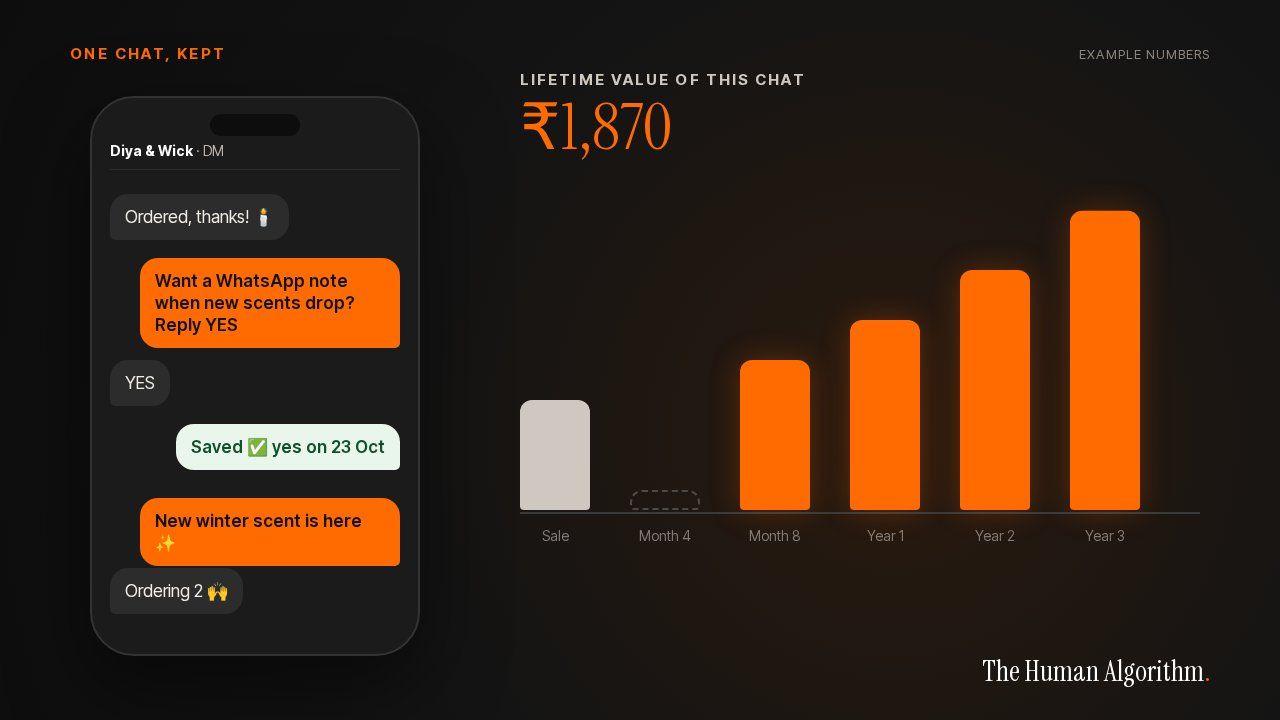
The WhatsApp 24 hour rule: when a customer messages your business, you can reply freely for 24 hours, and each new message from them restarts the clock. After that, the WhatsApp Business Platform lets you send approved templates, which are paid. Messenger and Instagram DMs also give you 24 hours, and up to 7 days when the chat came from a click to message ad. So the real asset is not one sale. It is a chat the customer keeps open with you, and their yes, written down.
Every week, Indian founders and creators close sales inside Instagram DMs. The buyer says thanks, the parcel ships, and the chat goes quiet. That quiet chat is where most of the money is lost.
Not on the sale you made. On every sale that same person could have made with you for the next three years, if you had kept a way to talk to them.
I have run growth for Indian brands since 2017, 25+ brands across D2C, coaches and creators. The pattern I see most is not bad ads. It is good buyers who are never heard from again.
Key takeawayA sale pays you once. A kept chat, with the customer’s yes on record, can pay you again and again. Meta’s 24 hour rule is the reason the yes matters so much.
Below: why a kept chat is worth more than a sale, a calculator for your own numbers, Meta’s real rules for WhatsApp, Messenger and Instagram DMs in one table, and a checker that tells you if you can message someone right now. Kavya’s fix took one line of text. You will see the exact line further down.
Meet Kavya, and the 140 buyers she could not call back
Kavya makes scented candles in Jaipur. She is a made up founder, but her year is real for a lot of people.
Last Diwali her reels took off. Her DMs filled up. She answered every message herself, late into the night, and sold 140 candles in one week. It was her biggest week ever.
Then January came. Her reach dropped to a third. She wanted to tell her Diwali buyers about a new winter scent. She opened her DMs and scrolled. Hundreds of threads, all ending with “Thank you 🙏”.
She thought about writing to them one by one. 140 chats, typed by hand, to people who never said they wanted updates. It felt like spam. And the reply tool she used during Diwali could not send them anything at all, because Meta’s 24 hour window had closed months ago. Her favourite customers were sitting in an inbox she did not control.
“I had 140 happy buyers,” she told a friend. “And I cannot call a single one.”
Up next Why those 140 chats were worth far more than 140 candles. It comes down to one idea most founders skip.
Why is a kept chat worth more than one sale?
Start from the basics. Every rupee a customer will ever give you comes from three things:
- How much they spend each time (order value)
- How often they buy (repeat buys a year)
- How long they stay (years)
Multiply them and you get lifetime value: what one customer is worth to you over the whole time they buy from you.
Now look at what a lost chat does. Order value stays the same. But how often and how long both drop to almost one. To sell to that person again, you have to find them again, usually with another ad.
A kept chat changes the other two numbers. You can tell them when their favourite scent is back. You can remind them before Diwali. You can answer a question in two minutes. Each of those is a chance for a repeat buy, and you do not pay for a new click to get it.
One sale vs one kept chat, the same customer
Sale, chat lostTo sell again, you pay for ads againone order
Sale, chat kept with a yesYou can reach them at the right momenta customer
An illustration, not data. Not every kept chat buys again. The point is the shape: the left side ends after one order, the right side can keep going.
This is not a new idea. Harvard Business Review summed it up in 2014: depending on the study and the industry, winning a new customer costs 5 to 25 times more than keeping one you already have. The same piece quotes Bain research by Frederick Reichheld: raising customer retention by 5% raised profits by 25% to 95%. Those are older studies from other markets, so treat them as direction, not a forecast for your brand.
Here is the part most guides miss. In India, the place a customer actually stays in touch with a business is WhatsApp.
Why WhatsApp is where an Indian customer stays
Up next Put your own numbers in. Most founders are surprised by the last box.
What is one saved chat worth? Do the math
Move the sliders to match your business. If you do not know a number yet, use a careful guess and come back when you do.
Three things to notice when you play with it:
- The share who come back matters most. Move it from 10% to 20% and the value of every chat you keep doubles on the repeat side.
- Keeping in touch is cheap next to winning a buyer again. A template to 100 people costs about ₹86 in India. Compare that with what you pay for 100 new clicks.
- It is a promise to the customer, not to you. People come back when your messages are useful. Spam a kept chat and the value drops to zero, fast.
Up next Not every chat is a kept chat. Instagram, Messenger and WhatsApp give you very different things to hold on to.
Instagram DM vs WhatsApp vs Messenger: what you actually keep
All three apps belong to Meta. That surprises people, so let us be plain about it. Moving a customer to WhatsApp does not take them out of Meta’s world. What changes is what you hold.
Three doors into a chat, and what each one lets you keep
Instagram DM
- Who holds the contact
- Instagram. You see a username, not a number.
- Can you start a chat?
- No. You reply to their message, or send one private reply to a comment.
- If reach drops or the account is restricted
- The thread is stuck inside the account.
Messenger
- Who holds the contact
- Your Facebook Page. Subscribers live there.
- Can you start a chat?
- With people who subscribed to your marketing messages.
- If Instagram reach drops
- Still works. It is a second door, not a vault.
- Who holds the contact
- You do: their phone number, plus their yes, dated.
- Can you start a chat?
- Yes, with their opt in. Outside 24 hours on the Platform, it is a paid template.
- If Instagram reach drops
- Still works. WhatsApp is also Meta, so the rules still apply.
Instagram DM is where most chats start, and where most of them die. Instagram holds the contact. You see a username. If your reach drops or your account is restricted, those threads go with it. Meta’s terms say it can suspend or disable accounts that break its rules, and mistakes happen too.
Messenger is a second door. A Messenger subscriber is tied to your Facebook Page, not your Instagram account. So when Instagram reach drops, Messenger still works. But it is not a vault. If the Page has trouble, so does the list.
WhatsApp is the closest thing to keeping the customer. You hold their phone number. With their yes, written down with a date and where they gave it, you can reach them even if your Instagram account vanished tomorrow. WhatsApp is also Meta, so it can still limit a number that spams. What you keep is the number plus a dated record of their yes. That record is yours.
Up next The rule behind all of this. It is the reason a “yes” is worth more than a follower.
The WhatsApp 24 hour rule and Messenger’s rules, in plain words
Here is the whole picture in one table. We read every line on Meta’s own pages on 23 October 2026. These windows are the rules for business tools that send through Meta: any reply tool, chatbot or shared inbox follows them.
| Channel | Free reply window | Ad window | What is paid | After the window | Consent you need |
|---|---|---|---|---|---|
| Instagram DM | 24 hours from their message | Up to 7 days after a message from a click to Direct ad | Meta’s messaging pages name no fee per message. You pay for the ad. | A real person can reply with the Human Agent tag, within 7 days. No templates. | They write to you, or comment (one private reply, within 7 days). |
| Messenger | 24 hours from their message | Up to 7 days after a message from a click to Messenger ad | No fee per message on the policy page we read. You pay for the ad. | Human Agent tag (7 days), one time notification (ask once), marketing messages to subscribers | A subscription before marketing messages. They can opt out any time. |
| WhatsApp Business Platform | 24 hours, restarts with each message from them | Reply within 24 h to a click to WhatsApp ad chat and a free entry point window opens, up to 7 days, all messages free | Templates outside the window (India: ₹0.8631 marketing, ₹0.115 utility). Service replies after 1,000 free a month. | Approved templates, paid | Their number and their opt in, with your business name stated |
| WhatsApp Business app (phone) | Meta says app messages are not subject to the 24 hour window | Not applicable | No fee per message | Normal chats, within WhatsApp’s policy | The same opt in rule as the Platform |
Five words you will see on Meta’s pages, in one line each:
- Customer service window: the 24 hours after a customer messages you on WhatsApp, when you can reply in any words you like. Each new message from them restarts it.
- Message template: a message you write in advance and Meta approves. On the Platform, it is the one kind of message you can send once the window has closed. Review can take up to 24 hours.
- Free entry point window: when someone messages you from a click to WhatsApp ad and you reply within 24 hours, Meta opens a window of up to 7 days where it charges for no message.
- Human Agent tag: on Messenger and Instagram, lets a real person reply to a customer within 7 days of their message. It is for people, not bots.
- Opt in: the customer’s clear yes to hearing from your business, by name. WhatsApp’s policy needs their number and this yes before you contact them.
How long you can reply freely, per channel
WhatsApp, normal chatresets each time they write
WhatsApp, from a click to WhatsApp adif you reply within 24 h
Messenger and Instagram, normal chata person can still reply
Messenger and Instagram, from a click to message adfrom their opening message
Two points most guides get wrong. Meta’s Messenger and Instagram policy page, updated 28 September 2026, now allows up to 7 days after a click to message ad. Many pages, and some AI answers, still say 24 hours. And Meta’s WhatsApp pricing page, updated 30 September 2026, says the free entry point window may stay open for up to 7 days.
One more, for small teams in India. If you reply from the WhatsApp Business app on your phone, Meta says those messages are not subject to the customer service window. The 24 hour rule is a Platform rule, for tools that send through Meta’s API. The opt in rule applies to both. So does the spam rule: people can block or report you, and Meta may limit how many messages a business can send.
Up next A tool for the question you ask ten times a day: can I message this person right now?
Can I message them now?
Pick the channel, how the chat started, how long ago they wrote, and whether they said yes. The checker tells you what Meta allows and gives you a line to send.
Click to WhatsApp ads vs click to Messenger ads
Ads that open a chat are the fastest way to start new chats you can keep. The two kinds now both give you up to 7 days, in different ways.
- Click to WhatsApp ads: the customer taps your ad and lands in a WhatsApp chat with you. Reply within 24 hours and the free entry point window opens for up to 7 days. Inside it, Meta does not charge for marketing, utility or service messages. Replies written by Meta’s own AI agent are still charged. A good fit when you sell in India and want the phone number.
- Click to Messenger ads: the customer lands in Messenger. Meta’s policy lets you reply freely for up to 7 days from their opening message, offers included. A good fit when your buyers live on Facebook, or when you want a second door that does not depend on Instagram.
- Click to Direct ads work like the Messenger version, inside Instagram DMs. Up to 7 days, then the chat goes quiet unless they write again. Use those 7 days to ask for the WhatsApp yes.
What an ad chat costs in India is mostly the ad itself. If you message the person again later on WhatsApp, a marketing template costs ₹0.8631 per delivered message and a utility one ₹0.115, from Meta’s rupee rate card of 1 October 2026. Our WhatsApp API pricing guide for India has the full table and a worked month.
The habit that pays: treat every ad chat as a 7 day chance to earn the yes. The sale is the start of the chat, not the end.
Up next The exact line Kavya now sends after every DM sale.
How to move a DM into a chat you keep, in 4 steps
1. Invite the DM. End one post a week with a reason to message you: a keyword to comment, a question, a free guide. Meta lets you send one private reply to a comment, within 7 days. Make it useful and end it with a question, so they reply and the full window opens.
2. Answer, then ask. Help them with what they asked. Then, in the same chat, ask if you can keep in touch on WhatsApp. Our DM scripts for coaches show this step word for word.
3. Ask for a clear yes. Meta’s opt in guide says the request must make clear they are opting in, and name your business. Here is a line in English and one in Hinglish:
English
Can I send you updates and offers from Diya & Wick here on WhatsApp? Reply YES and I will. Reply STOP any time to stop.
Hinglish
Diya & Wick se aapko yahan WhatsApp pe updates aur offers bhej sakte hain? Haan ho toh YES likh dijiye. Kabhi bhi STOP likh ke band kar sakte hain.
The same sale, two endings
Chat lost
Is the sandalwood candle in stock?
Yes! ₹850, link here 🙂
Ordered, thanks!
Thank you 🙏
Chat kept
Ordered, thanks!
Thank you 🙏 Want a WhatsApp note when the Diwali scents are out? Reply YES. STOP any time.
YES
Saved ✅ You will hear from Kavya at Diya & Wick, never spam.
4. Write down the yes. This is the step that makes the list yours. One row per person, in a sheet or your CRM:
The date and the place matter. If anyone ever asks, you can show when and where they said yes. And if your Instagram account goes quiet tomorrow, this sheet still works. For the full plan to grow that list, read own your audience, a plan for Indian creators.
The 7 days after the yes
A yes is a door opening, not a sale closing. What you send next decides if the chat stays alive.
- Day 0, a welcome reply. Thank them, say what you will send and how often, and how to stop.
- Day 2 or 3, one useful note. A care tip, a size guide, a short answer to a common question. No offer.
- Day 6 or 7, one easy question. “Which scent should we bring back next?” A reply restarts the 24 hour window and tells you what they want.
- After that, a rhythm you can keep. One message a week or a month, always worth opening. If someone says stop, remove them that day.
Our Day 1, 3 and 7 follow up templates have ready lines for each step.
Mistakes that get numbers blocked or Pages restricted
- Adding people to groups or broadcasts they never asked for. No yes, no message.
- Blasting the whole list with offers. People block and report, and Meta may limit how many messages your number can send.
- Using the Human Agent tag for sales pushes. It is for a person answering a customer, within 7 days.
- A bot with no way out. WhatsApp’s policy asks for a clear path to a human, like a handover in chat, a phone number or an email.
- No record of the yes. Without a date and a place, you cannot show that anyone opted in.
- Treating WhatsApp as a vault. It is Meta too. Respect its rules and keep a copy of your list.
What happened to Kavya?
Kavya did not change her product or her ads. She changed one line. After every DM sale she now sends the yes question, and she writes down every YES in a simple sheet.
By the end of the next month the sheet had 212 rows. Most of them came from chats she was already having. She sends one message a month: a new scent, a care tip, a heads up before a festival. A few people said stop. She removed them the same day.
Her story is made up, so the numbers are too. The part that is real is the shape. Her loyal buyers are no longer stuck in her Instagram inbox. They are in a chat she keeps, with a yes she can show.
Useful? Send it to your team or keep the 7 day plan.
Opens WhatsApp with the link ready. You choose who gets it. Save gives you a one page plan to print or keep as a PDF.
The numbers in one place
| Number | What it is | Source |
|---|---|---|
| 24 hours | WhatsApp customer service window, restarts with each customer message | WhatsApp Business Messaging Policy |
| Up to 7 days | Free reply window after a click to Messenger or click to Direct ad message | Messenger and IG policy, updated 28 Sep 2026 |
| Up to 7 days | WhatsApp free entry point window after you answer a click to WhatsApp ad chat within 24 h | WhatsApp pricing, updated 30 Sep 2026 |
| 7 days | Human Agent tag window on Messenger and Instagram | Messenger and IG policy |
| 1 message, 7 days | Private reply to an Instagram comment | Instagram private replies doc |
| 1,000 a month | Free WhatsApp service messages per business number | WhatsApp pricing |
| ₹0.8631 | Marketing template per delivered message, India | Meta INR rate card, 1 Oct 2026 |
| ₹0.115 | Utility template or service message after the free 1,000, India | Meta INR rate card, 1 Oct 2026 |
| Up to 24 hours | Template review time | WhatsApp templates overview |
| 500M+ | WhatsApp users in India | TechCrunch, Dec 2025 |
| 94% | Indian monthly users who opened WhatsApp daily, Nov 2025 | Sensor Tower via TechCrunch |
| 60%+ | Indian WhatsApp users who message a business account | TechCrunch, Oct 2023 |
| 5 to 25x | Cost of a new customer vs keeping one, by study | HBR, 2014 |
What should you remember?
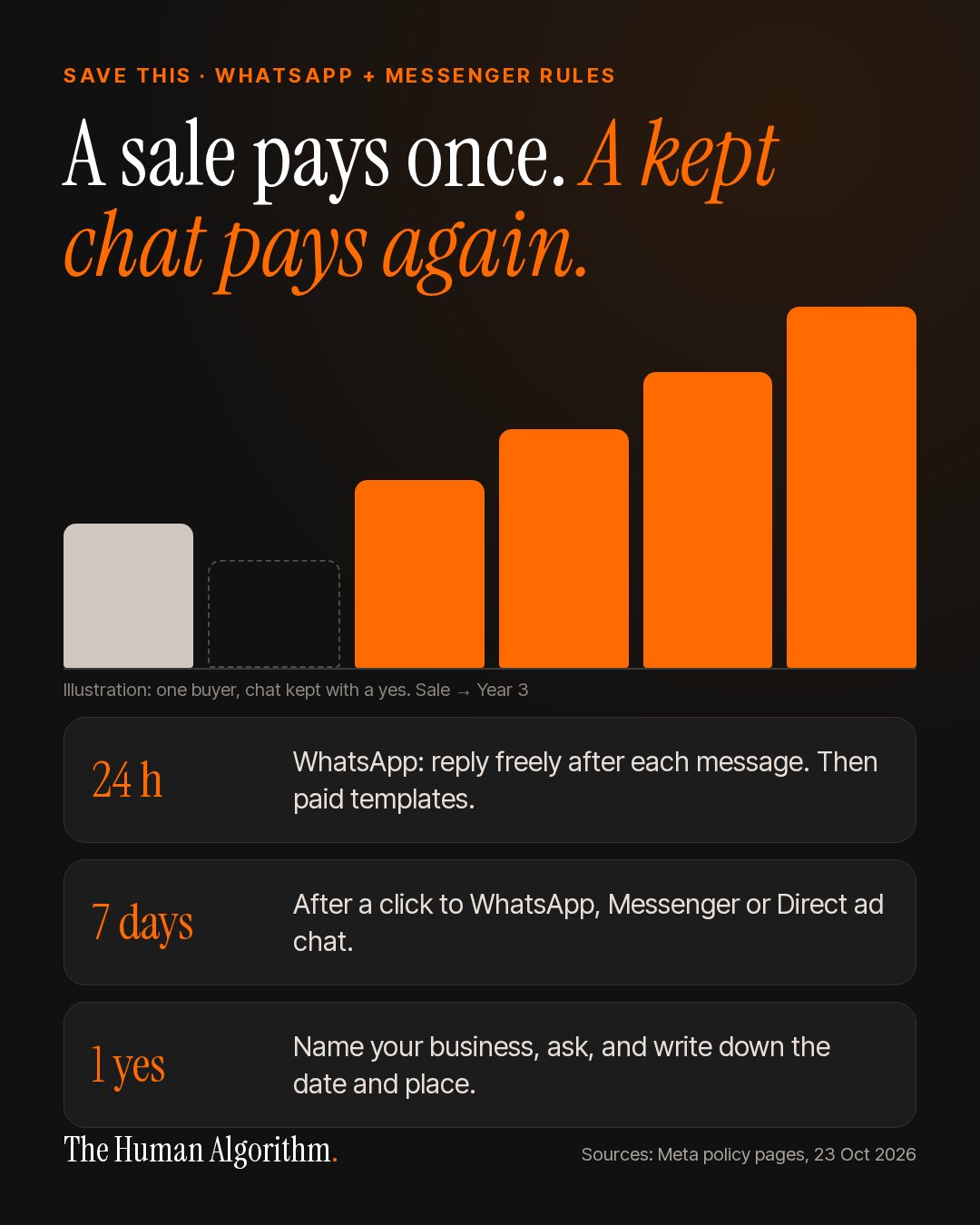
- A sale pays once. A kept chat, with a dated yes, can pay for years. That is lifetime value.
- WhatsApp: reply freely for 24 hours after each message. After that, the Platform needs a paid template.
- Messenger and Instagram: 24 hours, up to 7 days after a click to message ad, and a Human Agent reply within 7 days.
- Ask for the yes in the DM, name your business, and write down when and where they said it.
- WhatsApp is also Meta. What you keep is the number plus the yes, so treat both with care.
Sources (checked 23 October 2026)
- WhatsApp Business Messaging Policy (last updated 23 Sep 2026): number plus opt in before contact, the 24 hour customer service window that opens and resets with each user message, templates outside it, a clear path to a human.
- Messenger Platform and IG Messaging API policy (updated 28 Sep 2026): 24 hour standard window, up to 7 days after a click to Messenger or click to Direct ad, promotional content allowed in the window, Human Agent tag for 7 days, one time notification not on Instagram.
- Instagram messaging API (updated 28 Sep 2026): 24 hours, up to 7 days after a click to Direct ad, separate 7 day Human Agent window.
- Instagram private replies (updated 30 Jun 2026): one message to a commenter, within 7 days of the comment.
- Pricing on the WhatsApp Business Platform (updated 30 Sep 2026): free entry point window up to 7 days, 1,000 free service messages a month per number.
- WhatsApp template messages overview (updated 21 May 2026): templates are the message type allowed outside a customer service window, review can take up to 24 hours.
- Get opt in for WhatsApp (updated 16 Jun 2026): state that the person is opting in, and name the business.
- Onboarding WhatsApp Business app users (updated 26 Jun 2026): app messages are not subject to the customer service window.
- Marketing messages on Messenger: customers must subscribe, and can opt out any time.
- Meta Terms of Service: Meta can suspend or disable accounts that break its terms.
- TechCrunch, 14 Dec 2025: 500M+ WhatsApp users in India, 94% of Indian monthly users opened it daily in Nov 2025 (Sensor Tower).
- TechCrunch, 26 Oct 2023: more than 60% of WhatsApp users in India message a business account.
- Harvard Business Review, 29 Oct 2014: new customers cost 5 to 25 times more than keeping one, plus Bain research on retention and profit.
- India template rates (₹0.8631 marketing, ₹0.115 utility and service): Meta’s INR rate card from 1 Oct 2026, as set out in our WhatsApp pricing guide.
Questions people ask
What is the 24 hour rule on WhatsApp?
When a customer messages your business on WhatsApp, a 24 hour customer service window opens. You can reply in any words you like during it, and each new message from them restarts it. After it closes, the WhatsApp Business Platform lets you send approved message templates, which are paid.
Can I message a customer after 24 hours on WhatsApp Business?
Yes, with an approved template, if they gave you their number and said yes to hearing from you. In India a marketing template costs ₹0.8631 per delivered message from 1 Oct 2026. Meta says messages from the WhatsApp Business phone app are not subject to the 24 hour window, but the opt in rule still applies.
What is the Facebook Messenger 24 hour rule?
After a person messages your Page, you have 24 hours to reply freely, offers included. After a click to Messenger ad, Meta allows up to 7 days from their message. Past that, a real person can reply with the Human Agent tag within 7 days, or you can send marketing messages to people who subscribed.
Is there a 7 day window for click to Messenger and click to WhatsApp ads?
Yes. Meta’s Messenger and Instagram policy, updated 28 Sep 2026, allows up to 7 days after a message from a click to Messenger or click to Direct ad. On WhatsApp, replying within 24 hours to a click to WhatsApp ad chat opens a free entry point window of up to 7 days with no message charges.
What are click to WhatsApp ads?
Ads on Facebook and Instagram that open a WhatsApp chat with your business when tapped. The customer starts the chat, so you get their number. Reply within 24 hours and Meta does not charge for your messages for up to 7 days.
Instagram DM vs WhatsApp: which is better for keeping customers?
Instagram DMs are good for starting chats, but Instagram holds the contact and you cannot message people who never wrote to you. WhatsApp gives you the phone number. With the customer’s yes on record you can reach them even if your Instagram reach drops.
How do I move Instagram followers to WhatsApp?
Invite a DM in your posts, answer the question, then ask in the same chat if you can send updates on WhatsApp, naming your business. Send the link to your WhatsApp chat, and write down the date and place they said yes.
How do I get WhatsApp opt in?
Ask clearly, name your business, and say what you will send. A line like “Can I send you updates from [Business] on WhatsApp? Reply YES. STOP any time.” works. Keep a record of when and where each person said yes, and remove anyone who says stop.
Know a founder whose DMs are full but repeat orders are thin? Send them Kavya’s story.
Opens WhatsApp with the link ready. You choose who gets it.
Want this handled for you? Revenue Desk: a managed DM sales desk for brands, coaches and creators.
THA Circle
Use AI. Still sound human.
A free WhatsApp channel for founders, coaches and creators who want AI to save time without losing the human touch.
- On joining A welcome pack: 3 AI prompts and 5 chat scripts you can copy today.
- Monday A short script for your own chats. Ten minutes to try.
- Wednesday One real chat taken apart, names removed.
- Friday Human of the Week. A moment a customer felt seen.
Free. Takes ten seconds. Channel followers stay private. Leave any time.
The Sunday note
How people pay attention, and how to earn it. One email a week.
I study AI, attention, human psychology and marketing. Every Sunday I send one idea and one script for your chats. Five minutes to read. Reply any time, I read every answer.
Get the Sunday noteFree. Leave any time. Your email stays private.
 Scheduled messages on Instagram DMs
 Bring back WhatsApp enquiries that did not buy
 Should your WhatsApp bot say it is AI?